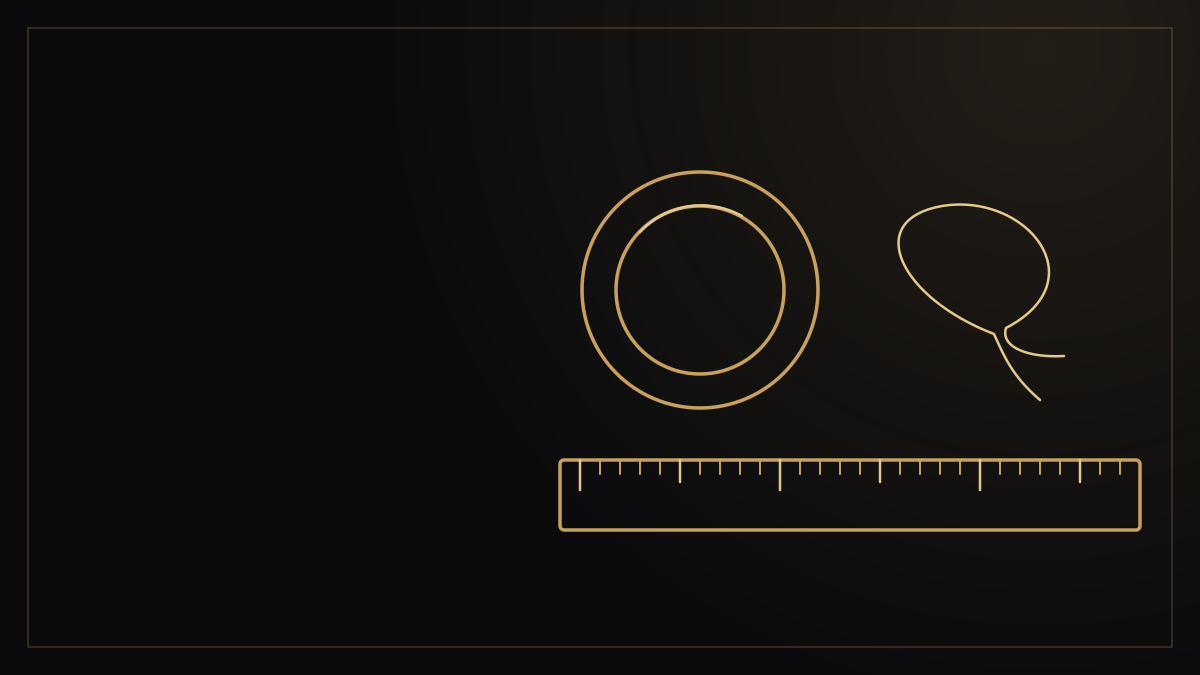
The sizes themselves
Ring sizes are just the inner circumference of the ring. The EU size is that circumference in millimetres: an EU 54 is a ring 54 mm around the inside. US sizes are a numbered scale that rises by about 2.55 mm of circumference per whole size. The UK uses letters. So whatever you measure, convert it to millimetres of circumference and the rest is a lookup.
Method 1: string and ruler
- Cut a thin strip of paper about 5 mm wide, or use a piece of string that does not stretch.
- Wrap it snugly around the base of the finger, over the knuckle if the knuckle is the widest point, so that the ring will actually pass over it.
- Mark where the strip overlaps with a pen.
- Lay the strip flat and measure from the end to the mark in millimetres. That number is your EU size.
- Repeat twice and take the average; a 1 mm difference is a third of a size.
Method 2: a ring you already own
Take a ring that fits the right finger well. Measure its inner diameter in millimetres with a ruler, edge to edge across the widest point of the hole, and multiply by 3.14 to get the circumference. A ring with an inner diameter of 17.2 mm is 17.2 x 3.14 = 54 mm around, an EU 54, about a US 6.75. Printed ring-size charts also work: lay the ring over the circles until the inner edge matches one exactly.
Size table
| Circumference (EU) | Inner diameter | US size | UK size |
|---|---|---|---|
| 50 mm | 15.9 mm | 5.25 | K |
| 52 mm | 16.5 mm | 6 | L 1/2 |
| 54 mm | 17.2 mm | 6.75 | N |
| 56 mm | 17.8 mm | 7.5 | O 1/2 |
| 58 mm | 18.5 mm | 8.25 | Q |
| 60 mm | 19.1 mm | 9 | R 1/2 |
| 62 mm | 19.7 mm | 9.75 | T |
Conversions are rounded to the nearest quarter size; makers differ slightly. When in doubt, give us the circumference in millimetres.
When to measure and common mistakes
Fingers swell in heat and after exercise and shrink in the cold, so measure in the evening at room temperature, when they are at their everyday largest. Measure the actual finger: left and right hands differ, often by half a size. Do not pull the string tight enough to dent the skin; the ring should slide over the knuckle with slight resistance and then sit comfortably. And remember width: a band 6 mm wide or more covers more skin and feels tighter than a slim one, so go up half a size.
If it is still wrong
Plain solid gold and silver bands can usually be resized one or two sizes by a jeweller; rings set with stones all around, very wide bands and plated pieces often cannot. Rings at DiOro999.9 list their size as the EU circumference; if you are between sizes or unsure, ask on WhatsApp before you order, and we tell you whether that particular ring can be adjusted.