You pay the portal again for a guest who already knows you.
The commission is not the painful part. Paying it a second time, on somebody who already knows your name, is.
The short answer
A portal is very good at one job, which is putting you in front of somebody who has never heard of you. It charges the same whether it did that job or not.
So the site is not there to beat the portal. It is there to take the guest the portal already introduced.
A portal is good at exactly one job
Being found by a stranger is worth paying for. A family choosing a coast they have never visited needs somewhere to compare, and no small site will ever be that.
The trouble starts the moment the stranger stops being one. Nothing in the arrangement notices that they came last August, liked it, and would have written to you directly if there had been anywhere to write.
The second stay is where the money is
Somebody who has already stayed is the cheapest booking you will ever take. They know the road, the beach and the kitchen, and they need no persuading.
If the only route back is the listing they first found, that booking carries the same cut as the first one did. The guest is yours and the introduction is being sold to you twice.
What we build for a place like this
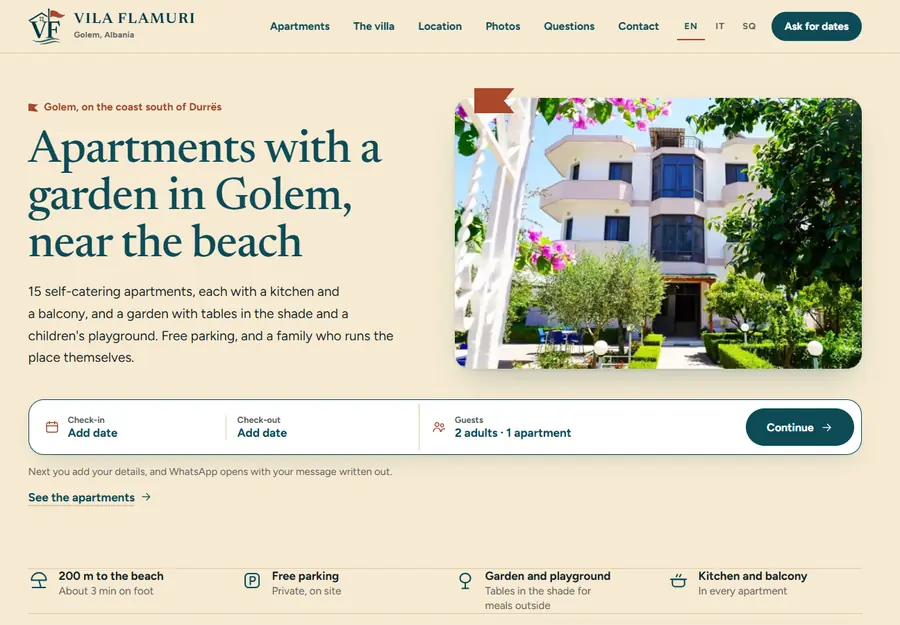
At Vila Flamuri the booking request is composed as a WhatsApp message, with the dates, the guests and the age of each child already written out. The family answers it themselves.
Nothing is held automatically. A house with 15 apartments answers faster than an availability system would stay truthful, and a calendar that lies once costs more than it ever saved.
The pages are in the languages the guests actually search in, and the site asks nothing of any other company in order to appear: no map tiles, no booking widget, no script from somebody else.
What this means beyond apartments
Any business that gets its first customer through a marketplace has the same arithmetic to do. The marketplace earns the introduction and then charges for the relationship.
The site worth building is the one that takes the relationship back, and it does that by being easier to write to than the listing is to reopen.
Questions worth asking
Should I leave the portals altogether?
No, and almost nobody should. They find the people who have never heard of your village, which is work you cannot do yourself. The point is to stop paying for the guests they are no longer finding.
Do I need live availability on the site?
Usually not, and often it is worse. A small place answers a message in minutes, and a calendar showing a free week you have already promised somebody costs you the guest and the good name at once.
Will guests trust a site they have not heard of?
They trust what they can check: real photographs, a real address on a map, the walk to the beach measured rather than guessed, and a person who answers. A thin page with bought images is what loses them.
What about payment?
Most small places here take payment on arrival and say so. If you want a deposit, a bank transfer named in the confirmation is enough to begin with. A card checkout is a bigger build and is rarely what stands between you and the booking.
How many languages do I need?
The ones your guests search in, which is rarely only your own. Look at where last season came from before deciding, because a language that brings you nothing costs the same to keep as one that does.
Is your business in the answer?
Ask now. Each link opens with the question asked.
Ask ChatGPT Ask Perplexity Ask Google See the map
Not named? The free audit shows why.
Tell us how many of last season's guests had stayed before, and we will tell you what the portal charged you for knowing them Get a free audit.
Updated